
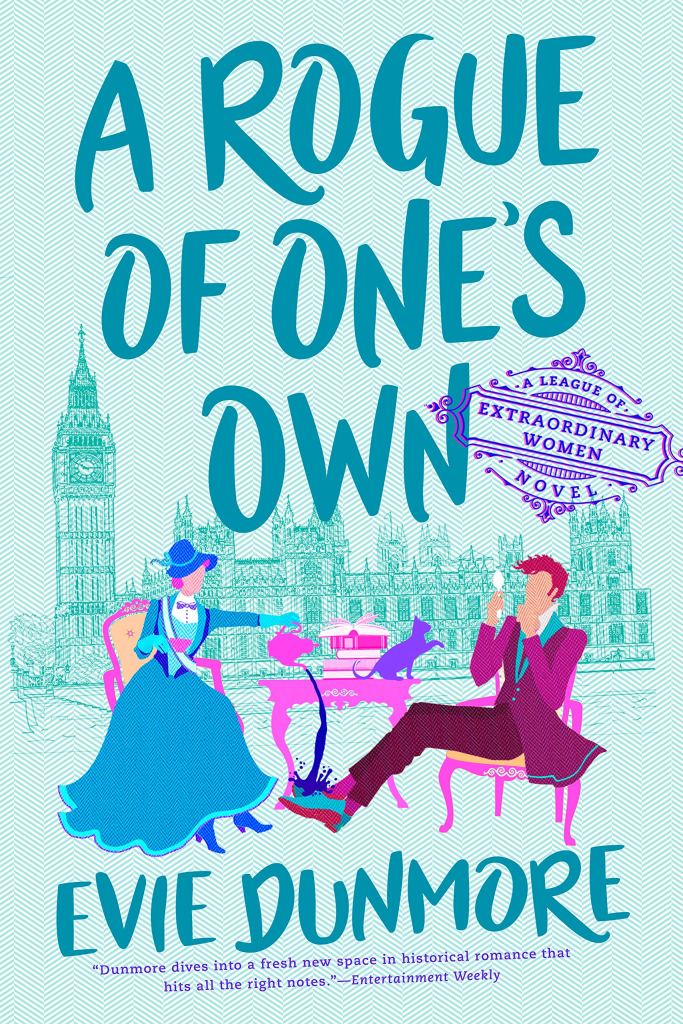
A ROGUE OF ONE’S OWN BY EVIE DUNMORE
PUBLISHED ON 1st SEPTEMBER 2020
GENRES: Romance novel, Historical romance, Historical Fiction.
PURCHASED THROUGH AMAZON E-BOOKS
SYNOPSIS
Lady Lucie is fuming. She and her band of Oxford suffragists have finally scraped together enough capital to control one of London’s major publishing houses, with one purpose: to use it in a coup against Parliament. But who could have predicted that the one person standing between her and success is her old nemesis, Lord Ballentine? Or that he would be willing to hand over the reins for an outrageous price—a night in her bed.
Lucie tempts Tristan like no other woman, burning him up with her fierceness and determination every time they clash. But as their battle of wills and words fans the flames of long-smouldering devotion, the silver-tongued seducer runs the risk of becoming caught in his own snare.
As Lucie tries to out-manoeuvre Tristan in the boardroom and the bedchamber, she soon discovers there’s truth in what the poets say: all is fair in love and war.
REVIEW
Evie Dunmore emerged onto the historical romance scene last year with Bringing Down the Duke, a tightly written, strongly characterised story which clearly marked the appearance of a fresh voice in the genre. So – with that runaway success under her belt, the question fans of the genre were asking was ‘can she do it again or was that a flash in the pan?’ Well, I’m here to tell you that she clearly can do it again, because in A Rogue of One’s Own, she once more tells a thoroughly entertaining story featuring compelling characters and a sensual romance that is very firmly anchored in its late Victorian setting, while also delivering a feminist message in a way that is properly entrenched within the fabric of the story and faithful to the character of the heroine.
I was impressed with the way the author incorporates the feminist message in this book. Lucies’s thoughts and feelings are incredibly well articulated and never come across as preachy or mere lip-service, but as essential truths.
Anyone who knows anything about the period will know that women had few (if any rights) and that the few that were eventually won took a lot of continual, hard work by many. (And that while many things have changed in the last 150 years, there are still many that have not). And while Lucie is outspoken and prepared to stand up for what she believes in she also recognises the need to operate within the limits of the society in which she’s living. She may be tough and determined, but there’s a vulnerable side to her she strives never to reveal, but which readers are allowed to glimpse as she wrestles with her conscience over her ability to continue to dedicate herself to her work should she become involved with Tristan.
Kudos to the author, too, for incorporating a bisexual hero into a mainstream historical romance. It’s not stated overtly, but it’s fairly clear that Tristan has had relationships with men as well as women (he even gets to flirt with Oscar Wilde at one point!), although this aspect of his character isn’t explored in any detail.
Electric chemistry, an intense attraction and a growing tenderness and understanding – the romance in this book works superbly on pretty much every level, although towards the end I started to feel as though Lucie was so overwhelmed by all the work she was undertaking and all the different directions she was being pulled in that she would never have time for a romantic partner in her life – and that impression, unfortunately, remained with me until the end. It’s one of the reasons this book didn’t quite reach DIK status. Another is that while it ends in what is probably the only way it could have ended and remained true to Lucie’s character, it’s a bit too pat and easy; for Tristan and Lucie to do what they do is pretty risky, especially given that discovery could pose a real threat to Lucie’s ability to continue her work.
MY STAR RATING
“Bewildering. If it was truly in woman’s nature to be an ever demure and pleasant sunbeam in the gloom, why then, it took an awful lot of ink and instructions to keep reminding woman of this nature of hers..”
“I’m afraid the idea that a woman is a person, whether married or not, is so inherently radical no matter which way I present it I shall be considered a nuisance.”
“I do not wish women to have power over men, but over themselves.”
 Starcrossed Lover